Blog Summary
Businesses importing pre-packaged commodities from China to India must comply with the Legal Metrology (Packaged Commodities) Rules, 2011 (LMPC). This involves obtaining LMPC registration and ensuring product labels carry mandatory declarations such as manufacturer details, country of origin, net quantity, and Maximum Retail Price. Crucially, these declarations must be affixed before customs clearance for home consumption, typically in a bonded warehouse. Importers should proactively verify label compliance and registration requirements, not relying solely on supplier labels, to ensure regulatory adherence and prevent import delays.
Importing products from China can be a good business opportunity for Indian importers, wholesalers, distributors and online sellers. However, before placing an order with a Chinese supplier, you must check whether your products need to comply with India’s Legal Metrology requirements.
One important requirement for businesses importing pre-packaged commodities is LMPC registration under the Legal Metrology (Packaged Commodities) Rules, 2011. These rules cover registration and declarations that help buyers understand what a package contains, how much it contains, who is responsible for the product and what price applies.
Getting the packaging wrong can result in additional work, delays and compliance costs. This is why importers should review their product labels and registration requirements before their first shipment.
In this guide, we explain the LMPC requirements for businesses importing products from China to India, the documents to prepare, the information required on product labels and the steps to complete before customs clearance.

What Is LMPC Registration for Imports from China?
LMPC stands for Legal Metrology Packaged Commodities. In common business usage, an LMPC certificate refers to the registration associated with Rule 27 of the Legal Metrology (Packaged Commodities) Rules, 2011.
These rules regulate specified declarations on pre-packaged commodities. They also provide for registration of businesses that import or pre-pack commodities for sale, distribution or delivery.
A pre-packaged commodity is generally a product placed in a package without the purchaser being present, where the package contains a predetermined quantity. The package does not necessarily have to be sealed to fall within the definition.
For example, a business importing ready-packed kitchen accessories, personal-care products or household goods from China for sale in India should assess whether the products fall under the applicable Legal Metrology requirements.
Importing a product from China does not automatically mean that every product needs the same registration. The product, packaging, intended use, applicable exemptions and other product-specific rules must be considered.
Businesses planning their imports should review the official Legal Metrology legislation and rules to understand the applicable requirements.
Which Products Imported from China May Need LMPC Compliance?

LMPC applicability depends on the nature of the product and how it is packaged and supplied in India.
1. Pre-packaged products for retail sale
Businesses importing products already packed in boxes, bottles, pouches, jars or other packages should check the applicable declaration requirements.
Examples may include:
- Kitchenware and household accessories
- Packaged personal-care products
- Stationery and selected consumer goods
- Toys, accessories and other packaged retail products
- Products sold through distributors, retailers or online marketplaces
These examples are illustrative, not a list of products that automatically require LMPC registration. The applicable rules and any product-specific requirements must be checked for the actual goods.
2. Bulk goods and industrial supplies
Products supplied in bulk or in packages intended for industrial or institutional consumers may be treated differently under the rules. Do not assume that a product is exempt simply because it is purchased in bulk or sold to another business. The package, quantity, intended use and conditions of the relevant exemption must be reviewed.
3. Products covered by other regulations
Some product categories have additional regulatory requirements. For example, food, cosmetics, medical devices and certain electrical products may be subject to separate legislation, labelling rules or mandatory approvals.
LMPC registration does not replace those requirements. Before shipping products from China, identify both the applicable Legal Metrology requirements and any additional product-specific requirements.
What Are the LMPC Registration Requirements for Importers?
Rule 27 of the Legal Metrology (Packaged Commodities) Rules, 2011 provides for registration of manufacturers, packers and importers covered by the rule.
The application particulars include the applicant’s name, the complete address of the premises where the relevant importing or pre-packing activity takes place, and the names of the commodities involved.
The registration requirements were amended in May 2026. The amendment added the name of the company director responsible for violations under the Act and rules. It also provides for annual updating of specified company or firm details through an online portal facility, including address, products and quantities from the previous year, and country of origin.
When should you apply for LMPC registration?
Rule 27 contains a 90-day application timeline linked to the commencement of the relevant importing or pre-packing activity. However, importers should not treat this as a reason to postpone compliance planning. Registration and product-label compliance are separate obligations. The time allowed for a registration application does not mean that mandatory package declarations can be omitted until after customs clearance.
Is central or state registration required?
The appropriate registration route depends on the applicable provisions and the business’s circumstances. Do not assume that one type of registration is automatically correct for every importer. If your business imports products for distribution across multiple states, confirm the appropriate route with the competent Legal Metrology authority before submitting your application.
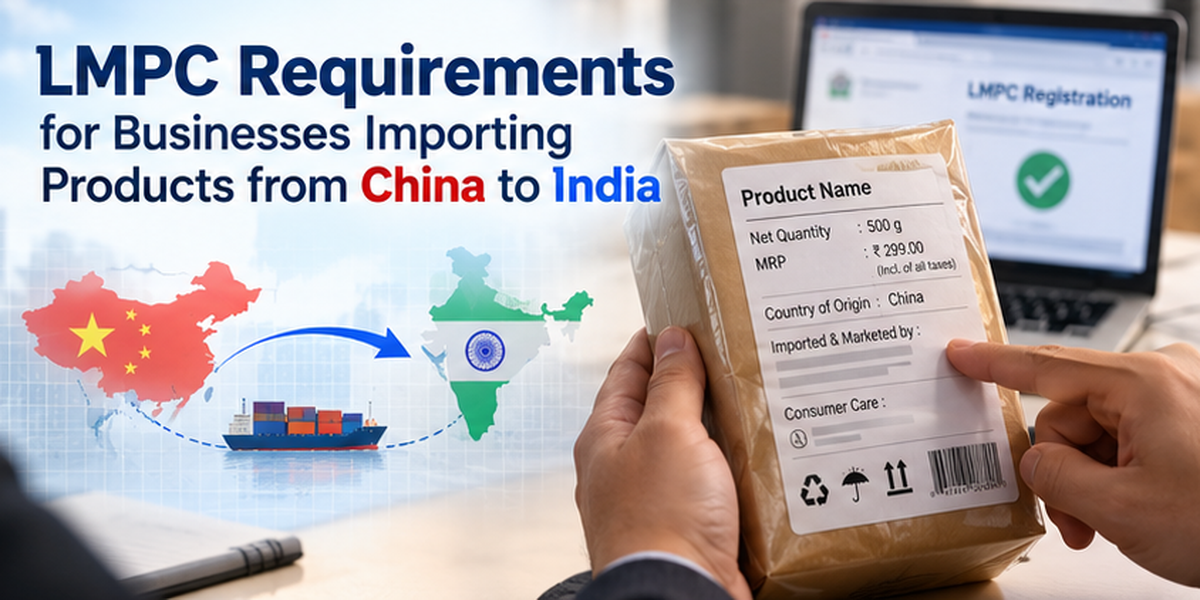
What Information Must Appear on Imported Product Labels in India?
Product packaging is one of the most important areas to review before importing goods from China. A Chinese supplier may already have printed packaging for its domestic or international customers. However, a label designed for another country may not satisfy India’s requirements.
The exact declarations depend on the package and the applicable rules. The table is a practical checklist, not a substitute for a product-specific label review.
You can consult the Department of Consumer Affairs’ Legal Metrology overview and the current rules and amendments before approving your final packaging.
1. Manufacturer and importer details
Check which manufacturer, packer and importer particulars must appear on the package. The information should be accurate and consistent with the relevant business records. Do not copy an address or company name from an old label without verifying that it is correct for the current import arrangement.
2. Country of origin
Imported products must carry the applicable country-of-origin declaration. For products genuinely originating in China, the declaration should accurately identify China in accordance with the applicable requirements. Do not confuse the country from which a product is shipped with its actual country of origin.
3. Product name and net quantity
Use a clear common or generic product name so that customers can understand what the package contains. Check the net quantity declaration as well. Depending on the product, this may relate to weight, volume, length, area or the number of units. The information should match the actual contents. A description such as “12 pieces” should not be used if the package contains a different quantity.
4. Maximum Retail Price (MRP)
The applicable rules govern the declaration of retail sale price, including the requirement relating to MRP inclusive of all taxes. Before approving the label, confirm the correct retail price declaration and ensure that the information satisfies the rules applicable to the product. Do not assume that the price printed on packaging designed for China or another overseas market can be used without changes.
5. Date and consumer-care declarations
Certain date declarations, such as best-before or use-by information, are particularly relevant to products that may become unfit for consumption or use after a period. Consumer-care details must also be checked against the requirements applicable to the product and package.
Where the product is subject to additional rules, those requirements must be considered alongside Legal Metrology declarations.
6. Additional declarations for specific products
Some products have special labelling conditions. For example, the September 2026 amendment to the Packaged Commodities Rules introduced specific red or brown and green dot declarations for products of non-vegetarian or vegetarian origin, respectively, in the case of soap, shampoo, toothpaste and other specified cosmetics and toiletries. Importers handling these product categories should review the Fourth Amendment Rules, 2026 and confirm how the requirements apply to their products.
When Must LMPC Declarations Be Affixed to Imported Products?
This is an important point for businesses arranging shipments from China. The Department of Consumer Affairs issued an advisory dated 8 October 2026 clarifying the implementation of mandatory declarations for imported pre-packaged commodities. The advisory states that the mandatory declarations required under the rules must be made before the goods are cleared by customs for home consumption and before the packages are offered for sale, distribution or delivery in the domestic market.
Importers with AEO Tier 2 or Tier 3 status
Importers holding Authorised Economic Operator (AEO) Tier 2 or Tier 3 status may be permitted to affix mandatory declarations at their approved importer premises where the applicable Customs procedures and instructions allow that arrangement.
Other importers
For other importers, the October 2026 advisory states that mandatory declarations are to be affixed in a customs-bonded warehouse under Section 57 of the Customs Act, 1962, or in the importer’s bonded warehouse licensed under Section 58, as permitted under Rule 4, before clearance for home consumption.
This means that an importer should not assume it can clear the goods first and correct the labels later at an ordinary warehouse or retail premises. Read the Department of Consumer Affairs advisory dated 8 October 2026 and coordinate with your customs broker before finalising the shipment plan.
What Documents Should You Prepare for LMPC Registration?
Preparing your documents in advance can make the application process easier. The exact requirements depend on the applicant, product category and relevant authority. The following is a practical preparation checklist rather than a claim that every item is mandatory in every case.
Business and applicant documents
Depending on your business structure, prepare the relevant:
- Certificate of incorporation, business registration proof or partnership deed.
- PAN and GST registration details, where applicable.
- Importer Exporter Code (IEC) details.
- Proof of the relevant business premises.
- Authorised signatory and representative details.
- Name of the company director responsible for violations, where required under the amended Rule 27.
Product and packaging information
Prepare the following product information:
- Product names and descriptions.
- Country of origin.
- Supplier and manufacturer details.
- Product quantities, weights or other relevant measurements.
- Sample packaging artwork or draft labels.
- MRP and other applicable declaration details.
- Supporting product specifications and supplier documents.
Keep the product details consistent across the application, invoices and packaging documentation wherever relevant.
Check the requirements before filing
Before submitting your application, check the current application form, prescribed fee, supporting documents and submission procedure with the relevant Legal Metrology authority. For assistance with the application process, review iKargos LMPC certification services.
Common LMPC Mistakes When Importing from China
Importers can often avoid unnecessary rework by checking a few important points before dispatch.
- Assuming that the supplier’s label is already compliant: A Chinese supplier may use packaging designed for its domestic market or another country. This does not establish that the label meets Indian requirements.
What to do: Review the actual packaging artwork before approving production. - Treating IEC or customs documents as a replacement for LMPC compliance: An IEC and the usual import documents serve different purposes from registration and declarations under Legal Metrology rules.
What to do: Check each applicable requirement separately. - Using an incorrect country-of-origin declaration: The supplier’s location, dispatch location and the product’s country of origin are not necessarily the same.
What to do: Obtain accurate origin information and ensure the declaration matches the product’s actual origin. - Assuming labels can be corrected after customs clearance: The October 2026 advisory clarifies the requirements for affixing mandatory declarations before clearance for home consumption.
What to do: Plan the label review and any permitted affixing procedure in advance. - Assuming every product has identical labelling requirements: Different products can be subject to different declarations, exclusions or additional regulatory requirements.
What to do: Check the rules against the actual product and package. - Forgetting to update registration details: The amended Rule 27 provides for annual updating of specified company or firm information.
What to do: Maintain accurate records of the address, imported products, quantities and country of origin, and confirm the current portal procedure.
What Should E-commerce Sellers Importing from China Know?
Businesses selling imported products through online marketplaces or their own e-commerce platforms should review both package-level and online-listing obligations.
The Legal Metrology (Packaged Commodities) Amendment Rules, 2026 introduced a requirement for e-commerce entities selling imported products to provide product listings through a searchable and sortable country-of-origin filter, effective from 1 July 2026. A further amendment published in April 2026 schedules revised wording for this provision from 1 July 2027.
Importers and sellers should therefore check the current provision and the future amendment when reviewing their online product listings. The applicable obligations may concern the e-commerce entity as well as the wider compliance checks needed by the importer.
Get Help With LMPC Registration for Imports to India
Importing pre-packaged products from China involves more than choosing a supplier and arranging transportation. Businesses should check whether LMPC registration applies, prepare the required documents, review the product labels and confirm the permitted label-affixing process before customs clearance.
Regulatory requirements can vary by product, and amendments may change the information that needs to be declared or the procedure that an importer must follow. Reviewing these matters early can help your business plan shipments more effectively and reduce avoidable compliance work.
Planning to import packaged goods from China? Explore LMPC registration support for importers from iKargos to understand the relevant documentation, application process and packaging-compliance requirements for your products.