Blog Summary
India's Paper Import Monitoring System (PIMS) is an online mechanism by the DGFT, mandating advance registration for specified paper products. Although many paper products are "Free" for import, PIMS registration is a compulsory condition, designed to capture pre-import data and address concerns like misdeclaration or dumping. Importers receive an automatic registration number, which must be declared on the Bill of Entry for customs clearance. Covering 201 tariff lines, PIMS remains mandatory, with non-compliance posing customs risks, despite ongoing stakeholder discussions about its potential withdrawal.
Importing paper products into India may appear straightforward when the product is classified as “Free” under the import policy. However, for a specified set of paper products, that “Free” status is subject to an important condition: compulsory registration under the Paper Import Monitoring System (PIMS).
PIMS is not a licence, and it isn’t a duty. It’s easy to lump it in with both, since it sits in the same paperwork pile as import approvals and shows up on the same Bill of Entry as customs charges. But the Paper Import Monitoring System is really something narrower and more mechanical: a data-capture layer that DGFT inserted in front of customs clearance for a specific category of goods. Understanding what it actually does rather than just what you need to file makes the whole system a lot less confusing, and explains why some of its rules exist in the first place.
For an importer, therefore, understanding how PIMS works is just as important as knowing how to complete PIMS registration. The timing of the application, the correct HS code, shipment information, registration validity and customs declaration can all affect whether a covered paper consignment moves smoothly through the import process.
This guide explains the PIMS mechanism step by step, including PIMS full form, PIMS registration, PIMS registration number, applicability, timing, validity, exemptions, customs clearance and common compliance mistakes.
What Is PIMS?
PIMS stands for Paper Import Monitoring System.
It is an online import-monitoring mechanism introduced by the Directorate General of Foreign Trade (DGFT) for specified paper and paper products. Under the system, importers provide advance information about covered consignments and obtain an automatic registration number by paying the prescribed registration fee.
PIMS was introduced through DGFT Notification No. 11/2015-20, dated May 25, 2022, which changed the import policy for specified products under Chapter 48 of the ITC (HS) classification from “Free” to “Free, subject to compulsory registration under PIMS.”
The core idea is simple even if the execution has multiple moving parts: a Bill of Entry only tells the government what happened after a shipment has already cleared customs. PIMS was built to generate shipment-level data before that point while there’s still time to flag something unusual.
What Problem Was PIMS Introduced to Address?
PIMS was introduced following concerns raised by the domestic paper industry about how certain paper imports were being recorded and monitored.
The Government’s 2022 announcement identified several concerns, including:
- imports being declared under generic “Others” tariff categories;
- dumping of paper products through under-invoicing;
- entry of prohibited goods through misdeclaration; and
- rerouting of goods through other countries in connection with trade agreements.
The policy therefore introduced an additional pre-import information layer for specified paper products.
This distinction is important. Customs already receives information through the Bill of Entry, but PIMS captures prescribed import information in advance of the expected arrival of the consignment. That gives the authorities another data point for monitoring covered paper imports. DGFT’s policy framework specifically requires advance information and links the resulting registration number to the later Bill of Entry.
How Does the Paper Import Monitoring System Work?
At a high level, PIMS follows a simple sequence:
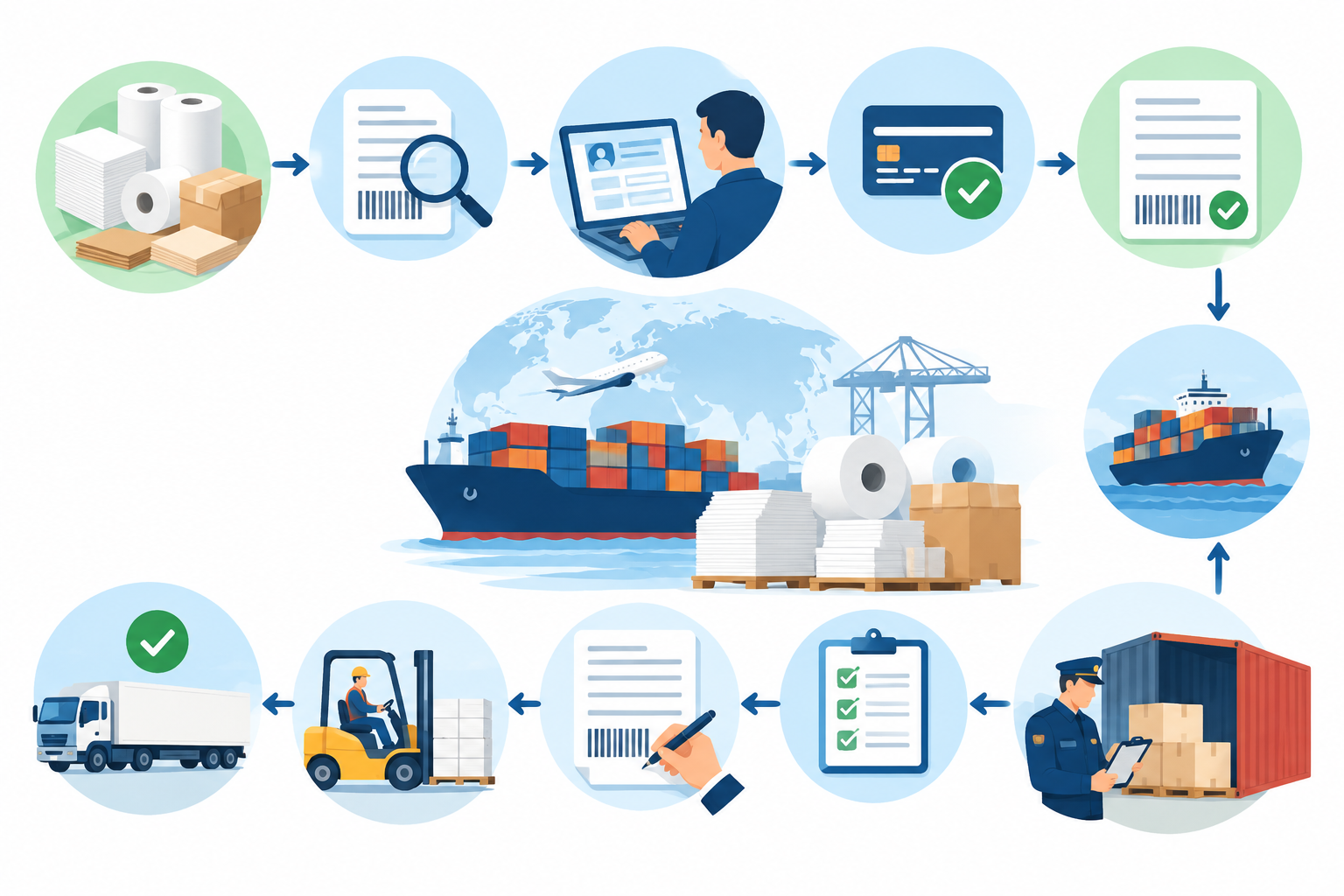
Identify the Product → Check the HS Code → Confirm PIMS Applicability → Prepare Import Information → Apply Online → Pay Registration Fee → Receive Automatic Registration Number → Import the Consignment → Declare Registration Number and Expiry Date in the Bill of Entry
The process is automated at the registration stage. DGFT’s notified framework provides for an automatic registration number after submission of the required advance information and payment of the ₹500 registration fee. The important point is that PIMS registration has to happen before the relevant import event. It is not something an importer should leave until cargo has already arrived at the port.
The Mechanism, Step by Step
Step 1: Pre-Arrival Registration on the DGFT Portal
Registration is filed on imports.gov.in, a separate interface from the main DGFT website, accessed through the importer’s IEC login. The importer declares the HS code, product description, quantity, value, country of origin and expected date of arrival.
Step 2: Automatic Number Generation
On successful submission, the portal generates the Automatic Registration Number (ARN, commonly referred to as the URN) instantly. There is no case-by-case review between submission and issuance.
This design detail is central to the current policy discussion around PIMS, addressed later in this article. Because the number is issued automatically rather than granted after review, the system’s practical effect is closer to a monitoring register than a licensing gate, even though it produces a document that functions like one at the customs stage.
Step 3: Declaration at the Bill of Entry
The URN and its expiry date must be quoted on the Bill of Entry. Customs verifies the presence and validity of the number; it does not re-examine the underlying declaration at this stage.
Step 4: Data Aggregation at DGFT
Each registration adds to a central database that DGFT can query at the tariff-line level, by product, origin country, volume or time period. This aggregation is the part of the system currently under the most scrutiny, discussed further below.
What Happens If PIMS Registration Is Not Completed on Time?
Failure to meet the PIMS condition can create customs and import-policy consequences. Although an affected product may appear under a “Free” import policy, the policy is conditional on compliance with the compulsory PIMS registration requirement. Recent Customs proceedings demonstrate that this condition is actively considered during adjudication.
In a 2026 Mundra Customs matter involving goods under CTH 48191090, Customs recorded that the goods were subject to mandatory PIMS compliance and that the importer had not obtained valid prior registration. The order treated the non-compliance as a violation of the applicable import-policy condition and discussed confiscation and subsequent clearance after a PIMS registration number was produced.
Which Paper Products Are Covered Under PIMS?
PIMS covers 201 notified tariff lines under Chapter 48.
The Government’s announcement describes examples including:
- newsprint;
- handmade paper;
- coated paper;
- uncoated paper;
- litho and offset paper;
- tissue paper;
- toilet paper;
- cartons;
- labels; and
- various other Chapter 48 paper products.
The original DGFT notification contains the detailed tariff-line annexure. Businesses should not rely exclusively on a general list of product names because the decisive question is whether the actual imported goods fall under a notified tariff item.
Which Paper Products Are Excluded From PIMS?
The Government specifically excluded certain categories from the mandatory-registration requirement. These include products such as:
- currency paper
- bank bond and cheque paper
- security printing paper
and other specified security-related paper categories. An exclusion should always be checked against the actual tariff classification and current notification rather than inferred from a product description alone.
Does PIMS Apply to Advance Authorisation and DFIA Imports?
DGFT clarified that PIMS registration continues to apply to covered paper imports regardless of the purpose or import scheme, including imports under frameworks such as Advance Authorisation and DFIA. The clarification also addresses EOU and SEZ-related imports. This means an importer should not assume that a special trade-policy scheme automatically removes the PIMS requirement.
PIMS and HS Code: Why Classification Matters
PIMS is closely connected to tariff classification because its coverage is defined by notified tariff lines. An importer may therefore face two separate questions:
What is the correct HS code?
and
Does that HS code fall under PIMS?
If the answer to the first question is wrong, the answer to the second can also become wrong. That is why paper importers should avoid selecting an HS code simply because it appears to have a more favorable duty treatment or because a supplier has historically used the same description.
The iKargos HS Code Search tool can be used for preliminary product-classification research. For more complex cases involving classification disputes, valuation or trade-policy implications, businesses can review iKargos Compliance & Trade Advisory.
Is PIMS Being Reviewed or Proposed for Withdrawal?
The policy discussion around import-monitoring systems has evolved beyond the original introduction of PIMS.
A High Level Committee on Non-Financial Regulatory Reforms under NITI Aayog, chaired by Rajiv Gauba, recommended revoking the Steel Import Monitoring System (SIMS) on the grounds that tariff-line import/export monitoring is already within DGFT’s functions and that an additional prior-registration mechanism can duplicate existing processes.
Separately, the Export Promotion Council for EOUs and SEZs (EPCES) has advocated discontinuation of PIMS and specifically raised concerns regarding PIMS application to SEZ/EOU transactions. In correspondence dated December 2025, EPCES stated that a stakeholder consultation had taken place and that a final decision on PIMS was still awaited at that time.
These developments should be described carefully.
The NITI Aayog committee’s recommendation concerned SIMS, not a government decision to abolish PIMS. EPCES’s request for PIMS discontinuation is a stakeholder representation, not itself a change in the law.
Therefore, unless and until DGFT officially changes the PIMS policy, importers should continue to comply with the applicable PIMS requirement.
How iKargos Can Help With PIMS Registration
PIMS involves more than obtaining an online registration number.
Businesses may first need to determine whether the product is covered, confirm the correct HS code, prepare the required information, submit the registration within the applicable window and coordinate the registration details with customs documentation. iKargos provides a dedicated PIMS Registration Service for businesses that need assistance with the registration process.
Where classification is uncertain, businesses can use the iKargos HS Code Search tool as an initial research step. For broader issues involving customs classification, valuation, trade policy and import compliance, iKargos also offers Compliance & Trade Advisory. And where PIMS forms part of an actual import shipment, businesses can also review iKargos Customs Clearance Services.
Conclusion
Understanding how PIMS operates does not reduce the risk of a registration error, particularly given the absence of an amendment mechanism after issuance. Businesses that prefer to have the applicability assessment, HS code classification and portal filing handled directly can use iKargos’s PIMS Registration service, which manages the process end to end within the applicable filing window.