Blog Summary
India's economy primarily relies on maritime trade, accounting for 95% of its volume. Port cargo volumes are consistently growing, bolstered by significant efficiency improvements, including halved vessel turnaround times and expanded capacity. India benefits from a unique geographic position offering a substantial maritime advantage. However, the underlying challenge is the complex supply chain ecosystem, which necessitates robust infrastructure, documentation, and seamless coordination beyond just the ships. Despite progress, India's logistics costs remain high at 8% of GDP, underscoring the need for businesses to optimize the entire multimodal trade journey.
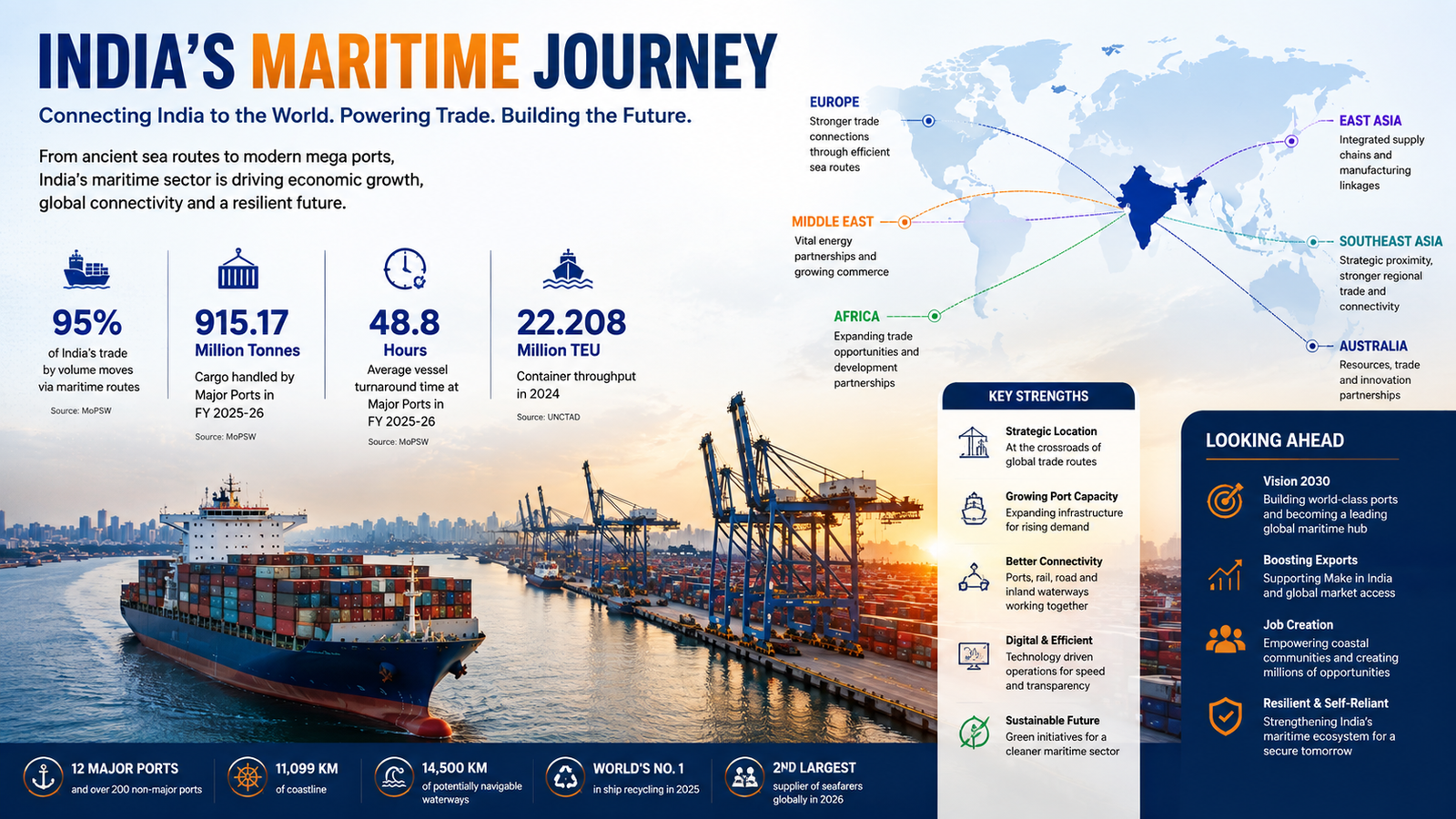
Roughly 95% of everything India trades by volume moves by sea. Not by air, not by road, not by rail – by ship. It’s one of those statistics that’s easy to read past, because it doesn’t feel dramatic. There’s no single headline moment attached to it, no ribbon-cutting ceremony. And yet it quietly explains more about how the Indian economy actually functions than almost any other number in circulation.
In the financial year 2024–25, total cargo handled across India’s ports, major and non-major combined crossed 1.594 billion tonnes, continuing a steady climb that’s held for most of the past decade. A year later, in FY2025–26, India’s twelve major ports alone handled 915.17 million tonnes, a 7.06% jump that comfortably beat the government’s own annual target of 904 million tonnes. Deendayal Port Authority led the pack at just over 160 million tonnes, followed by Paradip and Jawaharlal Nehru Port Authority (JNPA), each posting double-digit growth.
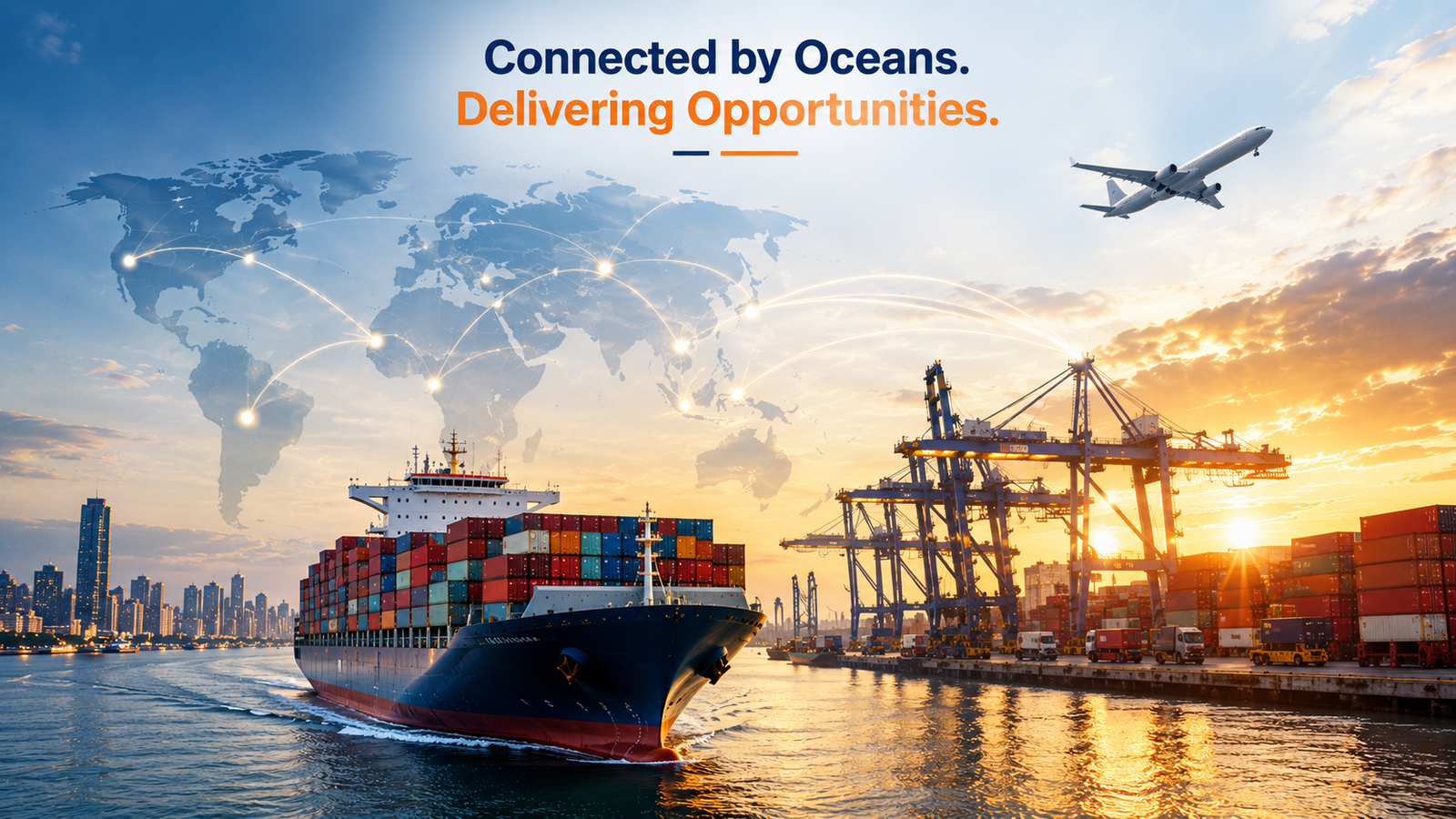
None of this happened suddenly. Major-port cargo has climbed almost every year this decade from around 705 million tonnes in FY2019–20, dipping briefly during the pandemic, then recovering to 819 million tonnes in FY2023–24, 855 million tonnes in FY2024–25, and now past 915 million tonnes. It’s not a spike. It’s a trend line, and trend lines are usually more revealing than single data points, because they tell you something is structurally changing rather than something that happened once.
It means that behind every one of those tonnes is a chain of decisions that has almost nothing to do with the ship itself. A shipment doesn’t move because a vessel exists, it moves because someone classified the product correctly, filed the right documentation, cleared customs on both ends, arranged inland transport, and tracked the cargo closely enough to know where it was at every stage. The ship is the most visible part of international trade. It’s rarely the part that determines whether a shipment arrives on time, at the cost it was supposed to cost.
That’s the real story hiding inside India’s port statistics not simply that more cargo is moving, but that an entire ecosystem of trade infrastructure, documentation, and coordination has to keep pace with it. And increasingly, that ecosystem is where the real competitive advantage sits.
Why India’s Location Gives It an Unusual Maritime Advantage
Geography doesn’t get discussed much in trade conversations, mostly because it feels like a fixed fact rather than a strategic one. But India’s position on the map is genuinely unusual, and it’s worth spelling out plainly rather than gesturing at vaguely.
India sits almost exactly between three of the world’s major trading blocs the Middle East to the west, Europe beyond it, and East and Southeast Asia to the east. It has direct coastline access to both the Arabian Sea and the Bay of Bengal, giving it two very different maritime gateways from a single landmass: one facing the Gulf and onward to Europe and Africa, the other facing Southeast Asia and the Pacific.
Add to that an Indian Ocean that carries a genuinely staggering share of global seaborne trade including the bulk of the world’s traded oil and India isn’t just near major shipping lanes. It sits inside them. Its coastline runs over 11,000 kilometres, dotted with a mix of major ports under central government control and a much larger number of non-major ports run by individual states, together forming one of the more extensive port networks of any single country.
A country’s geographic advantage only becomes an economic advantage when infrastructure can convert it into efficient trade.
That single idea is arguably the most important thread running through India’s entire maritime story right now. The country has the geography. The open question the one every port expansion, every logistics policy, and every private terminal investment is really answering is whether it can build the infrastructure fast enough to fully use it.
The Real Competition Is Not Between Ships – It’s the Supply Chains
It’s tempting to think of international shipping as a simple journey; factory, ship, destination. The reality looks more like: supplier, factory, inland transport, port, documentation, customs, vessel, destination port, customs again, inland transport again, warehouse, customer. Seven or eight distinct handoffs, often across two or three regulatory systems, all of which have to work in sequence for a shipment to arrive on time and at the cost it was quoted at.
The uncomfortable truth about supply chains is that they’re only as strong as their weakest handoff. A vessel can cross an ocean flawlessly and still arrive “late” from the buyer’s perspective, because customs paperwork on one end wasn’t filed correctly, or because a documentation mismatch triggered a hold that took four extra days to resolve. From the outside, that looks like a shipping problem. From the inside, it’s almost never actually about the ship.
This is why coordination and visibility have become such a central theme in modern trade not as a nice-to-have, but as the practical difference between a supply chain that’s predictable and one that isn’t. As India’s cargo volumes climb, this coordination problem doesn’t shrink – it gets larger and more consequential, simply because more cargo is now moving through the same finite set of ports, roads, and customs checkpoints. Volume without proportionally better coordination is a recipe for congestion, not competitiveness.
India’s Maritime Growth Is Also a Story About Efficiency
Handling more cargo is useful. Handling it efficiently matters considerably more, and this is where the story gets genuinely interesting rather than just large.
According to the Ministry of Ports, Shipping and Waterways, average vessel turnaround time at India’s major ports has fallen sharply over the past decade from roughly 94–96 hours in 2014 to about 48.8 hours in FY2025–26, effectively halving the time a ship spends waiting and working at an Indian port. That single figure understates its own importance. Turnaround time isn’t an abstract efficiency metric; it’s a direct cost. A vessel waiting longer at port means higher operating costs, tighter onward scheduling, container and equipment imbalances further down the network, and eventually, a factory somewhere waiting on components it was promised on a specific date.
Capacity has expanded alongside that efficiency gain. Total port capacity across India has grown from roughly 1,400 million tonnes per annum to around 2,760 million tonnes per annum over the past decade, driven substantially by the Sagarmala programme – a port-led development initiative that, as of an April 2026 update from the ministry, was running 845 projects worth a combined ₹6.06 lakh crore, with 315 of those projects worth ₹1.57 lakh crore already completed.
The programme’s stated purpose is broader than simply building more ports, it’s meant to improve coastal connectivity and the relationship between ports and the wider economy around them. That distinction matters more than it sounds. A modern port connected to poor inland roads still creates a bottleneck. A fast highway connected to a slow, congested port still creates a bottleneck. Efficiency has to hold at every link in the chain simultaneously, or the fastest link is wasted waiting on the slowest one.
Cargo, Containers, and What’s Actually Moving Through Indian Ports
It’s worth being specific about what “cargo” actually means here, because the container – the part of maritime trade that gets the most attention is only one piece of it. According to India’s Maritime Report, the country’s seaborne trade in 2023–24 broke down roughly as 40% dry bulk (minerals, grains, fertilisers), 32% liquid bulk (crude oil, chemicals, LNG), 25% containerised cargo, and the remainder break-bulk. Popular attention gravitates toward containers because they’re visually associated with manufactured goods and modern supply chains, but the wider system is also moving the raw materials and energy inputs that keep factories and power grids running.
India’s own container manufacturing capacity has historically lagged behind its container usage, with much of the country’s fleet imported rather than domestically built a dependency that showed up clearly during pandemic-era container shortages, when Indian exporters felt the global squeeze on box availability just as acutely as anyone else. That’s starting to shift: in mid-2026, the government announced India’s first domestically manufactured EXIM shipping container, built for Maersk, alongside plans to expand domestic manufacturing capacity further. It’s a modest step in absolute volume so far, but a symbolically important one for a country trying to control more of its own trade infrastructure rather than remain a price-taker on equipment it doesn’t make.
The Hidden Importance of Inland Logistics
It’s easy for a maritime story to focus entirely on the ocean, because ships are the visible part. But a meaningful share of the economic battle happens before and after the vessel in the hundreds or sometimes thousands of kilometres a container travels by road or rail before it ever reaches a port, and again once it arrives at its destination.
India’s inland waterways tell a quieter but genuinely striking version of this story: cargo movement through the country’s National Waterways rose from about 18 million tonnes in FY2013–14 to roughly 145.5 million tonnes in FY2024–25 close to an eightfold increase over a decade, and a signal that India’s maritime development is increasingly a multimodal story rather than a ports-only one. The future of Indian trade infrastructure isn’t simply about bigger ships arriving at bigger ports. It’s about how well ships, ports, rail, roads, waterways, warehouses, and digital systems connect to each other end to end.
Why India’s Logistics Cost Still Matters
Here’s a figure worth sitting with, because it complicates the otherwise straightforwardly positive story of rising port volumes and falling turnaround times: India’s logistics cost is estimated at roughly 8% of GDP, according to NITI Aayog’s Trade Watch a figure that remains a meaningful drag on export competitiveness relative to several peer economies.
That cost doesn’t begin at the port, and it doesn’t end there either. It starts with factory-to-port connectivity, a leg of the journey that’s often more variable than the ocean voyage itself. It continues through port handling charges, through customs delays (which, unlike shipping time, are notoriously hard to predict in advance), through warehousing on both ends of a shipment, and through last-mile distribution once goods finally reach their destination.
The reason this figure matters more than it might first appear is that reducing India’s logistics cost isn’t simply a matter of finding cheaper freight. Freight is one line item in a much longer chain of costs, and often not even the largest one. A business that negotiates aggressively on ocean freight but loses days to inconsistent customs clearance, or ties up working capital in inventory sitting at a port waiting on documentation, can easily end up worse off than a business paying a slightly higher freight rate but moving predictably through every other stage of the chain. The 8%-of-GDP figure is really the aggregate result of millions of individual shipments, each accumulating cost sometimes visible, often hidden at every one of the stages above.
Where This Leaves Indian Businesses
Put all of this together and a fairly coherent picture emerges. India’s ports are handling more cargo than ever, and doing it faster than they used to. Its geography gives it a genuinely rare set of advantages, and new infrastructure like Vizhinjam is beginning to change where and how cargo moves through the region. An enormous, largely uncelebrated workforce keeps the whole system running. At the same time, logistics costs remain high relative to peer economies, coordination across the many stages of a shipment remains the real determinant of whether trade actually runs smoothly, and the same geography that creates India’s advantage also creates its exposure to disruptions happening thousands of kilometres away.
None of that is a contradiction – it’s what a country in the middle of a genuine infrastructure transition actually looks like, real progress and real friction sitting alongside each other at the same time.
For the businesses actually moving goods through this system, the practical implication is that the ship is rarely the part of the journey worth worrying about most. It’s everything around it: whether a product was classified correctly before it ever reached a port, whether documentation was prepared in a way that wouldn’t trigger a customs hold, whether there was real visibility into where a shipment sat at any given moment, and whether the true landed cost of an international shipment – freight, duties, insurance, handling, inland transport, all of it was understood before a purchase decision was made rather than discovered afterward. Platforms that bring together trade data, tariff information and landed-cost intelligence can help businesses make that calculation before committing to an international transaction.
That’s the layer of Indian trade that doesn’t show up in tonnage statistics, but that ultimately decides whether a business experiences India’s maritime rise as an opportunity or as a source of unpredictable cost.